Pehla Pyaar Doosri Baar (2026): Sparsh Walia Leads a Reunion Romance That Fumbles Its Own Spark
The school reunion is the great liar of Hindi cinema: a dimly lit hall where everyone performs the version of themselves they hoped to become. Anuj Saini’s Pehla Pyaar Doosri Baar walks three lonely Delhi professionals into that hall, and for a while the film believes its own nostalgia.
A Drunken Road Trip Toward Crushes That Have Already Moved On
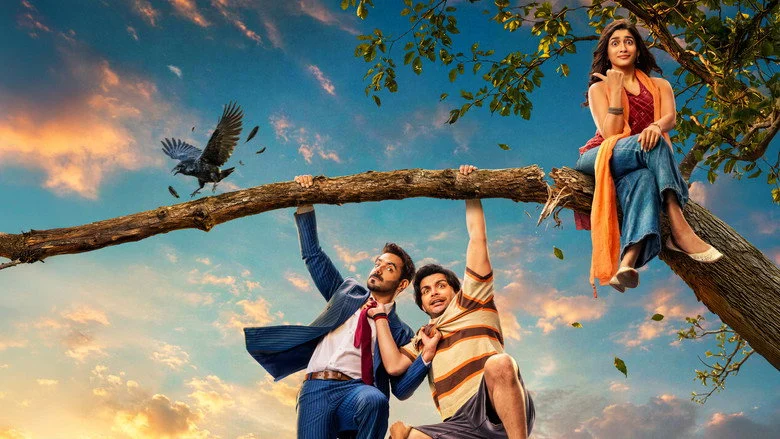
Gautam (Sparsh Walia), Vedant and Shivi are colleagues pinned under promotion anxiety, watching their peers marry off in batches. One long night of drinking converts that quiet humiliation into an impulsive drive from Delhi to the hills.
The screenplay sets up three parallel targets with almost mechanical symmetry: Gautam wants Gehna, Vedant wants Simran, Shivi wants Karan. It is a clean comic engine, and the film’s opening stretch runs on it without much friction.
What grounds this setup is the office itself. The corporate drudgery is not decorative; it explains why three adults would treat unfinished school crushes as a rescue mission worth funding out of their own pockets.
When A First Love Asks For A Second Lifetime
In Mussoorie, Gehna meets Gautam as a confident woman still raw from a recent heartbreak, and the intimacy that follows is the film’s most interesting stretch. Then she asks for permanence, and Gautam retreats into the exact commitment panic the movie has spent an hour mocking.
The reversal should sting. Instead it plays as a familiar beat, the same avoidance choreography that Tu Hai Meri Kiran at least had the nerve to complicate with suspicion rather than reflex.
Vedant’s track runs on a harder clock: Simran reciprocates his old feelings just as her fiancé Vikesh arrives to compress the reunion into a countdown before a wedding. The deadline gives the second half a shape, if not always a pulse.
Shivi’s arc is the messiest and the most revealing. She remakes her appearance to catch Karan, a serial womaniser, sleeps with him, and then understands that his “cute” was never a compliment she could convert into desire.
Three Performers Carrying A Script That Keeps Dropping Them
Sargun Kaur Luthra gives Shivi the film’s sharpest instrument: a blunt, gaali-fluent refusal of conventionally feminine presentation, delivered with a flat stare that makes her later makeover feel like a small betrayal of herself.
When Karan calls her cute, her correction, she wants to be called sexy, lands as comedy and diagnosis in the same breath. It is the one scene where the film’s writing and performance are pulling in the same direction.
Sparsh Walia plays Gautam with a shy, slightly hunched sincerity that works best in the reunion’s early, hopeful minutes. Once Gehna demands a future, his stillness reads as blankness rather than conflict, and the camera has nowhere to go.
Alisha Chopra’s Gehna is the more vivid presence in those scenes, whether tossing off a line about how being hot is its own burden or holding a look a beat longer than Gautam can bear. Her confidence exposes his hesitation without needing dialogue.
Kunal Vaid’s Vedant carries the conventional pursuit structure capably but without much interior life, and Gobind Singh Mehta’s Vikesh functions purely as an obstacle with a wedding date attached. The supporting romantic figures exist to create deadlines, not people.
Hill Nostalgia, Soulful Music, And A Middle Section That Refuses To Tighten
Saini shoots the Mussoorie reunion in warm, open hill light that deliberately clashes with the fluorescent flatness of the Delhi office. That contrast is the film’s clearest visual idea, and it does real emotional work early on.
The music is doing heavier lifting than the screenplay. Its soulful cues paper over the transition from three competing romances into one shared hangover, softening a structural seam the editing never solves.
That seam matters. The first half moves with the momentum of a road trip; the second fragments as Gautam’s withdrawal, Vedant’s wedding deadline and Shivi’s heartbreak compete for the same few scenes.
The final pivot, the trio abandoning their own disappointments to help Vedant win Simran back, gives the closing act a mission, but not a rhythm. The film narrows its objective without ever tightening its emotional escalation.
It also can’t resist the genre’s oldest furniture: the makeover, the delayed confession, the inconvenient fiancé, the commitment-avoidance third act. Udta Teer at least let its high concept mutate; this one simply rearranges the pieces.
Luv Ranjan’s Banner Bets On Newcomers While The Ledger Stays Grim
The film arrives under Luv Ranjan’s production umbrella, a banner whose commercial identity is built on friendship-driven romantic comedy and, increasingly, on launching unknown faces rather than bankable stars. That is a genuine strategic bet.
The opening-day India net of roughly ₹0.22 crore, as logged in live trade tracking, suggests the bet is not being rewarded at the box office. Newcomer-led rom-coms need word of mouth to compound; this one has neither a star nor a strong enough hook to generate it.
The wider exhibition math is unforgiving. A three-track romantic comedy with no franchise anchor and no marquee name is fighting for screens against sequels and event films, and a soft opening typically means the second weekend never arrives.
There is a broader lesson here about the remake-and-formula pipeline that Sumo Didi also ran into: sincerity of intent does not substitute for a reason to buy a ticket. Audiences have become ruthlessly efficient about distinguishing “pleasant” from “necessary.”
For a banner with this much production muscle, the more useful question is whether a film like this belongs in theaters at all, or whether the friendship-comedy audience has quietly migrated to streaming, where the margin for a messy middle is far kinder.
The Uncomfortable Lesson Buried In The Reunion Hall
Pehla Pyaar Doosri Baar ends where its title promises: with the recognition that first love is a story you tell yourself, and second chances require an adult you have not yet become. The problem is that the film reaches this idea through three arcs that never fully braid.
Shivi’s heartbreak is the one that lingers, because it is the only strand willing to admit that reinvention for someone else’s gaze is a losing trade. Gautam’s arc, by contrast, resolves into the genre’s default shrug.
What remains is a film with a real ensemble, a lovely hill setting, and music doing work the screenplay should have done. It is a competent calling card for its young cast and a cautionary note for its producers.
Nostalgia, this film quietly demonstrates, is a cheap ticket to sell and an expensive one to redeem. Pehla Pyaar Doosri Baar sells it well and redeems it only in fragments.

Ankit Jaiswal is the Chief Author, covering Indian cinema and OTT releases with honest, no-filler criticism. An SEO strategist by background, he brings a research-driven approach to film writing, cutting through hype to tell you exactly what's worth your time.