Sumo Didi (2026): Shriyam Bhagnani Anchors a Sincere Biopic That Never Quite Makes Weight
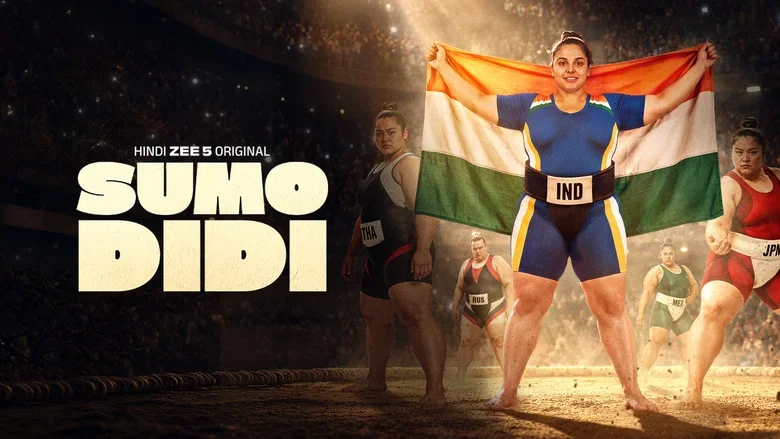
The opening shot of Sumo Didi lands in a Taiwanese arena, where a woman in a mawashi plants her feet and absorbs a charge before turning it into a win.
It is a confident hook, and for a moment the film looks like it might be the rare Indian sports drama that trusts its own physicality.
Then the rewind hits, nine months, a kitchen, a glass of bitter-gourd juice, and Jayant Rohatgi’s Zee5 original settles into the grooves of a biopic we have all seen before, executed with genuine feeling but uneven force.
A Hook That Promises More Than the Flashback Structure Can Deliver
Opening with Hetal Dave’s first international sumo victory before rewinding to her Kolkata childhood is a canny structural gamble. It gives the film a destination and reframes every humiliation as a step toward that ring.
The problem is that the flashback immediately surrenders the film’s physical energy to domestic exposition. We get PCOD, schoolyard mockery, a mother’s liposuction pamphlets, and a father who channels his daughter’s rage into judo, all necessary, none of it staged with the same conviction as that opening bout.
Where a sharper film might have intercut past and present to keep the athletic stakes alive, Rohatgi front-loads the backstory and lets the ring go cold for a long stretch.

Sudha Is the Film’s Real Antagonist, and Anubha Fatehpuriya Knows It
The screenplay’s smartest decision is refusing Hetal a villain in the conventional sense. The opposition comes from a mother who genuinely believes she is saving her daughter from social ruin.
Anubha Fatehpuriya plays Sudha with a tight, anxious mouth and a housewife’s brisk efficiency, measuring out bitter-gourd juice like medicine. Watch how she touches her daughter’s arm during the liposuction conversation, not cruel, just certain, which is somehow worse.
Nitesh Pandey’s Rajendra provides the counterweight, a quieter paternal presence whose best moment comes when he redirects Hetal’s anger after she strikes a mocking neighbour into judo drills rather than punishment. It is the film’s cleanest scene, and it earns the sports trajectory that follows.
Shriyam Bhagnani Carries the Weight, Sometimes Literally
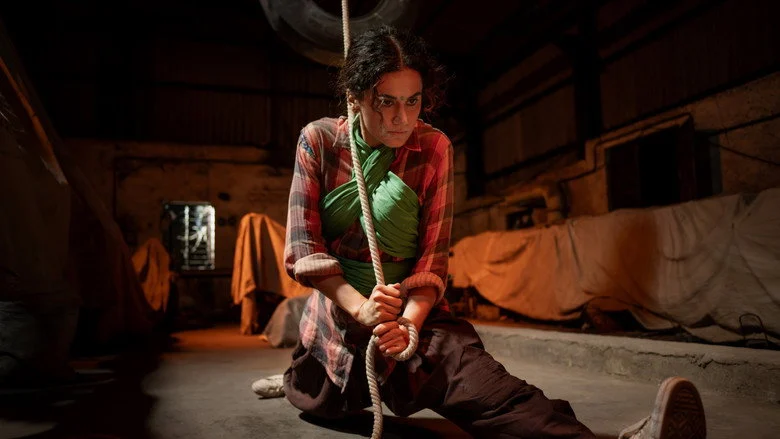
The film lives or dies on its lead, and Bhagnani commits in ways that go beyond the well-publicised physical transformation. In the ring, she uses her center of gravity with real intelligence, low stance, patient footwork, a willingness to absorb impact before countering.
Outside the ring, her best work is in the small retreats: the way Hetal’s shoulders fold inward at a family gathering, the flatness in her voice when marriage is mentioned for the third time in a scene. The humiliation is played as exhaustion rather than tears, which is the right call.
What she cannot fully overcome is a script that keeps telling us Hetal is a pioneer while showing us a fairly standard underdog arc. The performance is more specific than the material surrounding it.
The Sports Sequences Are Sincere but Rarely Propulsive
Here is where Sumo Didi loses its grip. The training montages are competently assembled, but they lack the escalating pressure that separates a great sports film from a good one, no ticking clock, no rival, no single match that feels genuinely in doubt.
That is partly the point, since women’s sumo in India has almost no infrastructure to dramatise. But the film mistakes scarcity of opposition for absence of tension, and the second half drifts toward its known conclusion rather than sprinting there.
The comparison to a film like Tu Hai Meri Kiran is instructive: that thriller understood that withholding information can be a weapon, while Sumo Didi withholds almost nothing and expects the audience to stay gripped anyway.
What it does get right is the body politics. The same frame mocked at a wedding is the frame that wins in Taipei, and Rohatgi stages that contrast without editorialising, domestic spaces are cramped and brightly lit, the ring is wide and indifferent.
A Familiar Biopic Rhythm That Occasionally Finds Its Own Beat
Nikhil Sachan’s screenplay fictionalises Hetal Dave’s life, which is fair enough, but it also smooths the edges that made her story worth telling. The childhood flashbacks are the weakest stretch, dutifully checking boxes rather than dramatising anything unexpected.
The middle section, where sumo enters the picture, is stronger because it lets Hetal discover something rather than merely endure. Her first attempt at the sport, awkward and off-balance, is more interesting than most of the later victories.
The film’s kinship with other contemporary Hindi dramas about self-definition is clear, though it lacks the narrative patience of something like Poniiy, which trusted silence and small gestures to carry emotional weight that Sumo Didi often assigns to dialogue.
There is also a tonal echo of the amnesia-comedy Udta Teer in how both films struggle to sustain momentum once their high concepts are established, though Sumo Didi’s sincerity covers more ground than that film’s escalating absurdity.
Zee5 Bets on Inspiration, Not Spectacle
As a Zee5 original, Sumo Didi is not chasing theatrical box office in the traditional sense, and that changes the calculus. The platform is clearly investing in the prestige-biopic lane, betting that Hetal Dave’s story, India’s first professional female sumo wrestler, carries enough novelty to justify the budget.
What is at stake for the streamer is credibility in the sports-drama space, a genre where its catalogue is thinner than its rivals’. A well-received entry here could open doors for more unconventional Indian athletic stories.
Commercially, the film’s ceiling is modest. It has no theatrical window to speak of, no franchise potential, and its lead is not yet a marquee name. But in the streaming economy, a sincere, critically respectable biopic can still function as a calling card, and this one likely will.
The broader question is whether audiences raised on the kinetic intensity of mainstream sports cinema will accept a film that treats its climax as recognition rather than triumph. Across contemporary hindi dramas, that patience is increasingly rare, which makes Sumo Didi something of a test case.
The Ending Wins the Match but Not Quite the Argument
The Taiwan match, when we finally return to it, plays with more confidence than the training sequences that precede it. Bhagnani’s Hetal is calmer here, more settled in her own body, and the film wisely resists a rousing final speech.
What it does not resist is the impulse to frame her victory as a national milestone rather than a private one. The closing text about her pioneering status is earned, but it also reveals the film’s central limitation: it is more comfortable celebrating Hetal Dave than interrogating her.
Still, there is something quietly radical in a film that lets a woman’s body be the site of her triumph rather than her shame, and does so without a villain to defeat or a man to validate her. That is worth something, even when the execution wobbles.
Sumo Didi does not fully solve the problem of how to dramatise a pioneer whose greatest achievement was simply refusing to disappear. But it stands close enough to her that you can feel the weight she carried, and, for a film this sincere, that may be enough.

Ankit Jaiswal is the Chief Author, covering Indian cinema and OTT releases with honest, no-filler criticism. An SEO strategist by background, he brings a research-driven approach to film writing, cutting through hype to tell you exactly what's worth your time.