Little Thomas (2026): Hridansh Parekh Anchors a Gentle, Single-Track Goa Memory
The piano has not been tuned in months, and the seven-year-old has begun to suspect the silence is his fault. Kaushal Oza’s Little Thomas walks into that quiet house in Fontainhas, Goa, circa 1990, and refuses to raise its voice.
A Child’s Arithmetic That Adds Up to a Baby Brother
Thomas Miranda (Hridansh Parekh) is the only child in a neighbourhood of siblings, and he has done the math. If the family is unhappy, the missing variable is a little brother, and if a brother requires a kiss, then a kiss is simply a task to be scheduled.
The premise is genuinely disarming because it refuses adult vocabulary. Money is not called money; it is the thing that makes his father’s shoulders slope and his mother’s answers short.
When Theatrical Restraint Becomes Repetition
Oza’s screenplay runs on a single rail, and for the first hour that discipline feels like confidence. Thomas’s schemes, a staged dinner, a mistimed errand, a carefully engineered proximity between two tired adults, land with the small, sincere thud of a child who has never been told no.
Yet the rail never forks. Just as Doosra arrived in theatres with a formal conceit it could not sustain past its own midpoint, this film repeats its one objective until the audience has outpaced the hero by a comfortable margin.
Around the ninety-minute mark the repetition curdles into tedium. The boy wants the parents to kiss; the parents are tired; the boy tries again. That is the entire engine, and it is running on fumes before the climax asks it for a final surge.
Two Adults In a Room Deciding Not to Speak
Rasika Dugal plays Jessie with her shoulders pulled inward, a piano teacher whose professional patience has been quietly redistributed to strangers. Watch her hands at the kitchen counter: they keep working while her eyes stay fixed on a point past her husband’s ear, refusing the eye contact that would require a real sentence.
Gulshan Devaiah’s Desmond carries his baker’s exhaustion in the flour dust on his forearms and the way he sits down before he has decided to sit. His silences are not sulks; they are the economy of a man who has calculated that speaking costs more than it earns.
The two of them generate a specific, recognisable domestic weather, not cruelty, just depletion. It is the same withholding that hollowed out the standoff in Dhood (Sandstorm), where a performance built on restraint eventually starved the drama around it.
The Boy Who Believes Logistics Can Fix Love
Parekh is the film’s true load-bearing wall, and he plays Thomas without a trace of precocity. His conviction that a kiss is a mechanism, a switch to be flipped rather than a feeling to be felt, is delivered with the flat seriousness of a child explaining a rule he has personally verified.
There is a moment where he watches his parents argue and does not cry, does not intervene, just recalculates. That stillness is more affecting than any outburst the screenplay could have handed him.
His arc bends from certainty to recognition, and Parekh finds the bend in his body before the dialogue catches up. It is a performance of small physical adjustments, a tilt of the head, a pause before answering, rather than emotional declaration.
Period Texture, Unhurried Frames, and One Missing Escalation
The 1990s setting is doing real dramaturgical work, not just production-design nostalgia. A world without instant answers is a world where a seven-year-old must construct his own theory of conception from fragments, and the film’s comedy depends entirely on that information gap.
Oza’s camera stays low and patient, letting doorways frame the adults at a child’s eye level so that every argument is half-overheard. The Fontainhas lanes are shot in the flat, unglamorised light of a real afternoon, and the film never once reaches for a picturesque postcard.
What the direction will not do is escalate. The staging is content to restate its own emotional situation, and the second half pays for that comfort, the same patience that made the setup humane starts to read as inertia.
What the Film Shares With a Reunion Romance It Cannot Match
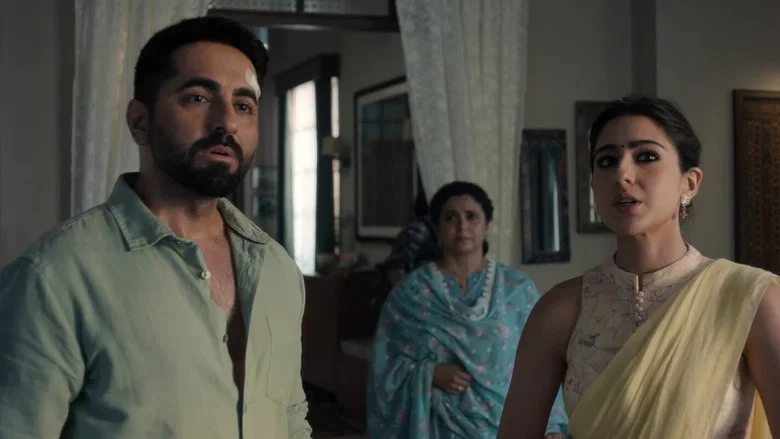
Both this film and Pehla Pyaar Doosri Baar bank on the belief that affection, once named, will arrange itself into a plot. Neither quite earns the third act it reaches for, though Oza’s film is the more honest about the cost of that failure.
Its resolution is deliberately unmagical: Thomas learns that closeness cannot be manufactured by scheduling a kiss, and the film lets that knowledge sit without a rescue. It is a small, adult mercy granted to a child character, and it lands because the screenplay resists the temptation to reward him.
The Ledger Behind a Small Film With a Small Opening
Four banners, Luminoso Pictures, Civic Studios, Good Bad Films and Flip Films, pooled resources behind an intimate Goa-set family drama with no stars carrying the marquee and no franchise scaffolding. That is a bet on the festival-to-multiplex pipeline, and it is a bet the exhibition market did not reward.
Trade assessment of the opening was bleak, with visibility thin and collections negligible across locations, which places Little Thomas in the same commercial ditch as several recent small-format Hindi dramas. The star leverage belongs entirely to Dugal and Devaiah, both of whom have built reputations in exactly this register, and exactly this budget tier.
The broader lesson for contemporary hindi family dramas is that gentleness alone is not a marketing strategy. A film this quiet needs either a sharper structural escalation or a festival runway to convert word of mouth into footfall, and it appears to have arrived with neither.
The Verdict: A Tender Film That Forgets to Grow Up With Its Hero
Little Thomas is at its best when it trusts its own modesty, and at its weakest when it mistakes repetition for patience. Parekh’s performance is the reason to sit through the sag, and the parents’ wordless exhaustion is the reason to remember it afterward.
But a film built on a child’s single theory must eventually test that theory with escalating pressure, and this one mostly restates it. The result is a gentle, sincere, structurally undernourished memory piece, lovely to look at, harder to stay awake for.
Oza has made a film about a boy who believes love can be assembled like a clock. The tragedy is that the movie around him never quite finds the second hand.

Ankit Jaiswal is the Chief Author, covering Indian cinema and OTT releases with honest, no-filler criticism. An SEO strategist by background, he brings a research-driven approach to film writing, cutting through hype to tell you exactly what's worth your time.