Karuppu (2026): Suriya’s restrained deity-lawyer anchors formulaic but earnest fantasy drama
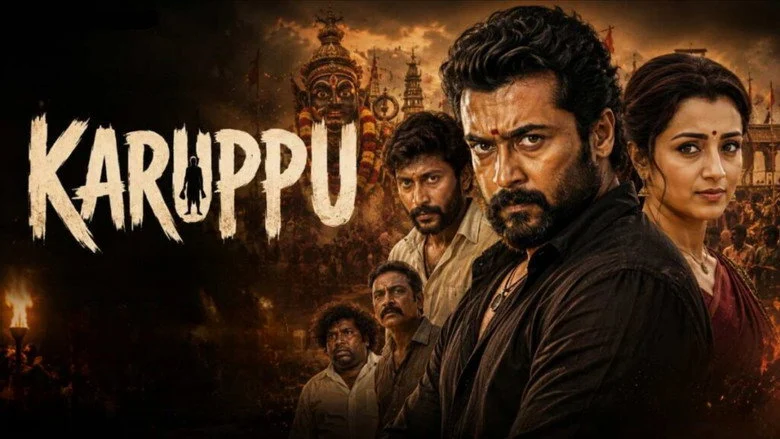
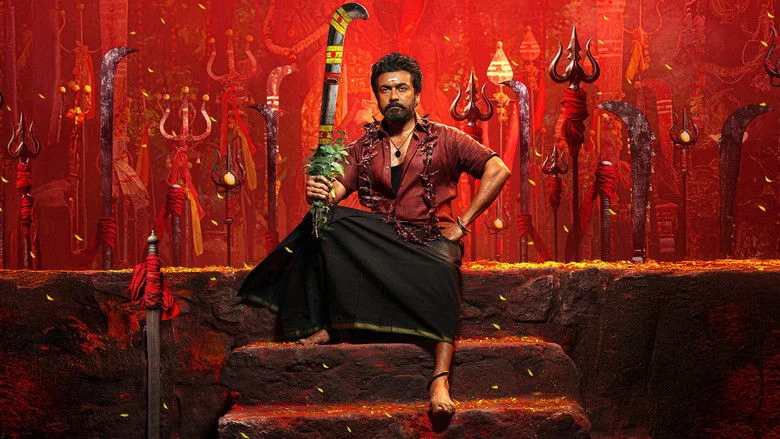
Karuppu, directed by RJ Balaji, arrives as a fantasy, action drama that asks a provocative question: what happens when divine justice enters a corrupt legal system? Suriya plays a dual role as Karuppuswamy/Saravanan, a deity disguised as a lawyer fighting for a child’s medical care. The premise is conceptually strong, but the execution walks a familiar path that will satisfy genre fans more than those seeking narrative surprise.

Lead Performance: Suriya’s dual identity demands control
Suriya anchors the story through a dual identity that demands both restraint and authority. His controlled courtroom dialogue delivery stands out, particularly in sequences where the deity must operate under human legal constraints. The shift between human disguise and divine presence requires consistency across tonal changes, and Suriya largely delivers, though the character’s divine nature occasionally reduces dramatic tension.
Direction and Screenplay: High, concept hook meets formulaic structure
RJ Balaji’s direction builds a high, concept hook: a deity acting as a lawyer in a corrupt system. The screenplay, credited to a team including Rathna Kumar and Ashwin Ravichandran, follows a linear structure, establishing the family crisis in the first half and escalating into courtroom confrontation in the second. However, the material relies heavily on a familiar divine, intervention template, limiting narrative surprise and risking comparison with earlier films in the subgenre.
Genre Execution: Fantasy grounded in legal and medical stakes
The film blends fantasy, action, and drama by using divine possession/disguise as its central mechanism. The court system becomes the main arena for conflict, translating moral judgment into legal argument, which gives the premise a concrete stake.
Anchoring the action around corruption and legal obstruction rather than purely physical conflict is a smart choice. The emotional specificity of a child awaiting a liver transplant grounds the fantasy in a human problem that the audience can invest in.
Yet the execution becomes predictable when the script leans too heavily on the divine concept instead of procedural detail. The courtroom sequences work best when the protagonist is forced to argue within human rules, but stretches of conventional commercial drama dilute the tension.
For more reviews and updates on Tamil cinema, visit the Tamil Action reviews.
Supporting Cast: Emotional anchors and procedural support
Trisha Krishnan provides the main female presence, supporting the emotional side of the transplant, and, family arc. RJ Balaji appears as Baby Kannan, likely offering comic or procedural support within the court setup. Indrans embodies the emotional weight of the father figure tied to the sick child, making the human cost of the legal conflict tangible. The antagonist functions more as a corrupt, system force than a detailed individual, defined through legal obstruction.
Audience Response and Reception: Mass hit with mixed critical notes
The film received mixed, to, positive critical response, with praise for its courtroom conflict structure and Suriya’s dual role, but criticism for its formulaic divine, intervention template. Audience feedback highlights the lead performance, the child, transplant conflict, and the action, drama blend, while noting predictability and uneven balance. No major controversies are documented, though Aju Varghese reportedly appeared in a cameo without remuneration. The film became the highest, grossing Tamil film of 2026 and Suriya’s biggest hit, indicating strong mass appeal despite critical reservations.
Karuppu works best as a crowd, pleasing fantasy drama that leverages Suriya’s star power and a socially relevant premise. Viewers seeking a strictly realistic legal drama may be disappointed, but those open to divine, intervention narratives with solid courtroom sequences will find enough to engage with. The film earns a verdict of 3.5 out of 5.
For a look at another performance, led Indian film, read our Sampradayaini Suppini review.
And check out Dhurandhar verdict with a dual role narrative.

Ankit Jaiswal is the Chief Author, covering Indian cinema and OTT releases with honest, no-filler criticism. An SEO strategist by background, he brings a research-driven approach to film writing, cutting through hype to tell you exactly what's worth your time.