Vaazha II (2026): Savin SA’s Reel-Energy Sequel Takes Real Risks
A young Hashir watches his father die, then turns to face a pregnant mother and an empty house, and in that single quiet moment, Savin SA’s sequel announces it has grown up, at least partially. Vaazha II: Biopic of a Billion Bros carries that weight into a comedy-drama about four friends crushed beneath the Gulf-dream expectations of every Malayali household, and it earns its laughs precisely because it understands the grief underneath them.
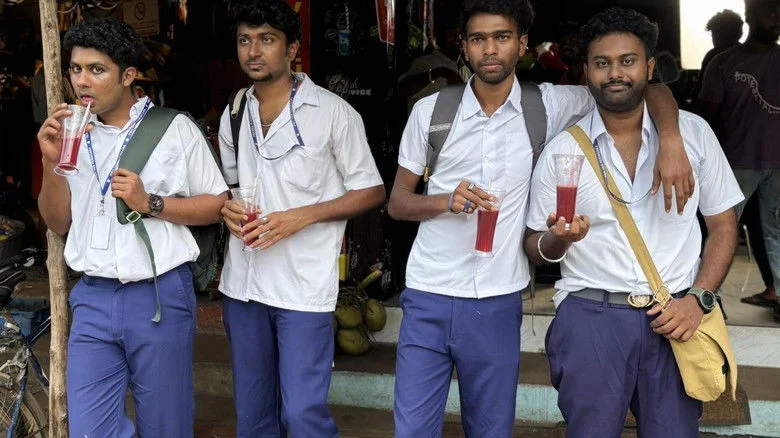
Hashir carries the film on instinct, not technique
The four leads, Hashir, Alan, Vinayak, and Ajin, play versions of themselves with a loose, unforced naturalism that trained actors often can’t manufacture. Hashir, in particular, anchors the emotional register. When the film asks him to shift from comic timing to domestic grief, he does it without announcement.
I found myself genuinely surprised by how little he oversells the harder scenes. That restraint is rarer in Malayalam youth films than it should be.
Savin SA widens the canvas, then trips over the frame
Savin SA sticks closely to the predecessor’s template while stretching its emotional and geographical reach, migration anxiety, family obligation, the particular humiliation of being called a loser by people who love you. The ambition is clear and largely earned.
The screenplay, written by Vipin Das, moves in a linear structure through school friendship, early love, and social pressure. There are no jarring plot holes. But the script never truly accelerates into something unexpected, it follows the groove it cut in the first film rather than digging a new one.
The comedy-drama engine runs hot, then idles
As a comedy-drama, the film operates on reel-like energy, punchy, propulsive, built from short bursts of humour and sharper bursts of feeling. It progresses like a sequence of well-crafted moments that, strung together, almost constitute a coming-of-age portrait.
The migration critique lands harder here than in the original. The screenplay takes the unspoken Malayali obsession, go abroad, become valid, and turns it into something genuinely uncomfortable. That social honesty gives the comedy its teeth.
But the film rarely slows down long enough to let a scene breathe. One critic noted it was “a fun ride that needed to slow down at times, ” and that’s accurate. The Hashir household scene, with its grief and sudden responsibility, needed more space than it receives.
If you’re looking for more Malayalam comedy-drama reviews with this kind of social edge, Malayalam Drama reviews on this site cover the wider genre landscape.
Vijay Babu and Aju Varghese do heavy lifting in light scenes
Vijay Babu, Aju Varghese, and Biju Kuttan form the adult support structure around the younger cast. Aju Varghese in particular finds the comic timing that the film’s tone demands, he never overplays, never disappears. Biju Kuttan brings grounded warmth to a film that might otherwise feel untethered from adult reality.
Alphonse Puthren’s presence adds a certain knowing wink, a filmmaker comfortable enough in his own cinema persona to be generous inside someone else’s film.
The audience has already decided this is the better Vaazha
There are no significant controversies surrounding the film, no censorship rows, no political flashpoints. What exists instead is a clear audience verdict: the sequel is considered far superior to the 2024 original, particularly in its handling of migration expectations and its message about self-worth outside the abroad-or-failure binary.
Publication responses support that reading. “Quirky, funny and grounded: Vaazha II hits the right notes, ” noted one review, while the broader critical consensus acknowledges the film’s charm even while flagging its reluctance to reinvent its own template. A runtime of 2 hours and 2 minutes is lean enough that the pacing problems don’t become fatal.
If the ambition of a young cast taking on generational anxiety reminds you of Anil Kapoor’s recent turn in a similarly conflict-driven film, the Subedaar 2026 review is worth reading alongside this one.
Vaazha II is worth your evening, particularly if the first film left you wanting more emotional consequence and less sketch-comedy looseness. It’s still reel-shaped at its core, and it still refuses to fully commit to the harder story it keeps gesturing toward. But it is warmer, sharper, and more honest about what it costs to grow up in a family that has already decided your future.
Vaazha II: Biopic of a Billion Bros earns a 3 out of 5, a sequel that outgrows its predecessor’s charm by finding real emotion in the joke, even if it never quite finds the courage to sit with that emotion long enough to let it scar.
For another 2026 film grappling with high ambition and uneven execution, the Dhurandhar The verdict makes for a pointed double feature.

Ankit Jaiswal is the Chief Author, covering Indian cinema and OTT releases with honest, no-filler criticism. An SEO strategist by background, he brings a research-driven approach to film writing, cutting through hype to tell you exactly what's worth your time.