Reporting Live (2026): Parineeti Chopra’s Investigative Thriller Buries Its Own Story
Dhruv Tripathi’s debut opens on the kind of premise that should make executives nervous: a field reporter and her reluctant cameraman stumble onto an illegal sand-mining operation, and the deeper they dig, the fewer people want them breathing. It is a clean engine. It is also, in practice, an engine running on three cylinders.
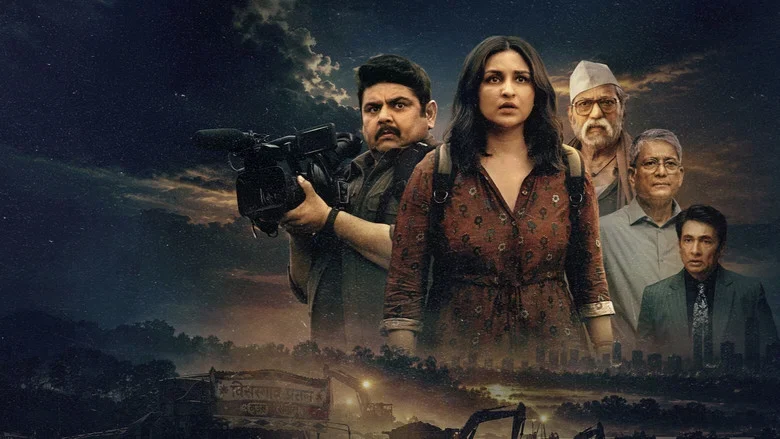
Parineeti Chopra plays Sandhya, an ambitious journalist who treats a routine assignment like a personal crusade. Deven Bhojani’s Vinod, her veteran cameraman, spends the first act sighing at her idealism and the second act discovering he was right to. The pairing is the film’s sturdiest beam, and the only one that doesn’t wobble under scrutiny.
What the screenplay never solves is the antagonist problem. The sand mafia is a collective, an abstraction, a shadowy “they” that intimidates, conceals, and occasionally kills without ever producing a face worth fearing. Just as Tripathi’s contemporaries demonstrated a tighter spatial discipline in Hanuman Ansh, the filmmaker here strips away any recognizable villain architecture to prioritize institutional dread, a choice that reads as thematic sophistication but plays as dramatic evasion.
When The Camera Becomes A Character, The Film Finally Breathes
The most compelling sequences are the least eventful. Sandhya and Vinod crouched behind a truck at dusk, camera rolling, breath held, this is where Tripathi shows genuine instinct. The film’s visual grammar in these moments is documentary-adjacent: handheld, tight on faces, refusing the comfort of a wide establishing shot. The audience is placed inside the hiding spot, not above it.
Bhojani is the revelation. His Vinod carries the weight of a man who has seen enough stories go sideways to know this one will too. Watch his hands in the second act, the way he grips the camera strap during an argument, the way he checks the rearview mirror three times in a single minute of dialogue. It is physical acting of the highest order, and it exposes how thinly Sandhya’s internal life has been written.
Chopra’s performance is committed but trapped. The screenplay gives her resolve and little else, no family, no history, no contradiction. Her Sandhya is a professional function, not a person. The film asks her to carry the moral weight of journalism itself, which is a burden no performer can shoulder without a script that gives them somewhere to put it down.
The Sand Mining Racket Is Real; The Thriller Around It Is Not
Illegal sand extraction is a genuinely sinister criminal economy, environmentally devastating, politically protected, and violent in ways that rarely make headlines. The film understands this intellectually. It rarely makes us feel it. The syndicate’s operations are described more than dramatized, and the political corruption angle is gestured at rather than confronted.
This is where the comparison to tighter procedural work becomes instructive. The cop-versus-cop tension that gave Daayra its cold, careful momentum came from institutional pressure applied to specific people in specific rooms. Tripathi’s film has the institution but not the rooms. Its villains operate at a distance, and distance breeds indifference.
The second-act escalation, Sandhya and Vinod realizing they are being followed, then hunted, should be the film’s spine. Instead, it becomes a series of near-misses that never quite land. The chase sequences are competent but anonymous, staged with the energy of a director who knows what a thriller should look like without quite knowing how one should feel.
Adil Hussain And The Art Of Doing More With Less Screen Time
Among the senior ensemble, Adil Hussain does what he has done in every Hindi film for the past decade: arrives, occupies a single scene with quiet authority, and leaves before you can fully register what he brought. His character is underwritten, but Hussain fills the gaps with stillness and a voice that suggests decades of compromise. The restrained, almost exhausted precision he brought to Max, Min and Meowzaki finds a darker register here, a man who has made peace with a system he once tried to fight.
The rest of the supporting cast is largely decorative. Amol Palekar and Shekhar Suman appear in roles that could have been played by anyone with a pulse and a suit. The film’s ensemble is its marketing pitch and its missed opportunity, a collection of talented performers given nothing to perform.
The Ending Refuses To Commit, And That Is The Real Crime
Without spoiling what little resolution exists, the final act retreats from the confrontation it has been promising for ninety minutes. The film’s tagline, “some stories refuse to be buried”, is ironic given how carefully the screenplay buries its own climax. The syndicate’s fate is ambiguous. Sandhya’s victory, if it can be called that, is pyrrhic in a way that feels less like moral complexity and more like narrative exhaustion.
Tripathi has talent. His instincts for intimacy, the way he frames two people in a car, the way he lets silence do the work of dialogue, suggest a director who could make something genuinely unsettling with a sharper script. What he has made instead is a film that gestures at importance without earning it, that wants to be about journalism’s courage without ever making us feel the cost.
This is a competent, watchable, ultimately forgettable entry in the current wave of contemporary Hindi thrillers, a film that understands the shape of the genre but not its pulse. Parineeti Chopra deserves a better vehicle. Deven Bhojani deserves a lead role. The sand mafia deserves a movie that actually shows us what it does.
Rating: 2.5 / 5
Some stories refuse to be buried. This one just refuses to fully arrive.

Ankit Jaiswal is the Chief Author, covering Indian cinema and OTT releases with honest, no-filler criticism. An SEO strategist by background, he brings a research-driven approach to film writing, cutting through hype to tell you exactly what's worth your time.