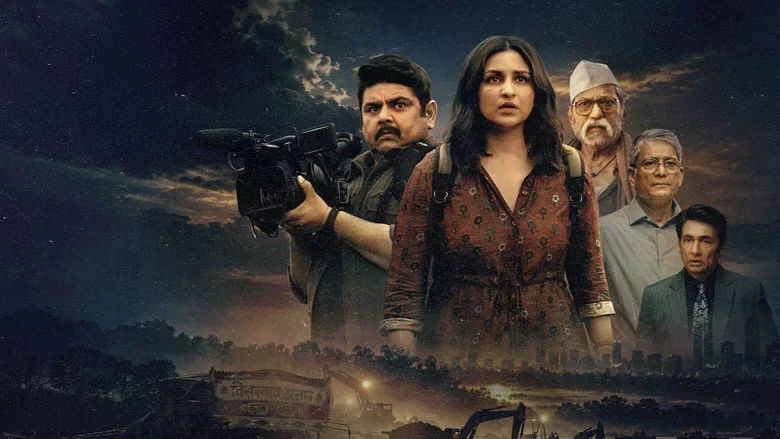
Tu Hai Meri Kiran (2026): Sonakshi Sinha Anchors a Thriller That Mistrusts Its Own Best Idea
Somewhere in the second act of Tu Hai Meri Kiran, a woman answers a phone call and learns that her memory of her own life is no longer hers to certify.
That is the film’s best idea. It is also the idea the film spends the rest of its runtime nervously backing away from.
A Flip Phone Between 2016 and 2026 Is a Trapdoor, Not a Gimmick
Karan Rawal’s premise is genuinely nasty in the productive sense: bestselling author Kiran, living in 2026, finds an old handset that connects her to Samar, a socially isolated man stranded a decade behind her.
What begins as an eerie intimacy curdles fast. Samar’s affection hardens into refusal, and refusal into surveillance, and surveillance into demands about who Kiran used to be in 2016.
The device is a clean suspense object, tactile, ugly, obsolete, and Rawal understands that its power is not magic but access. Every ring is a door unlocking from the wrong side.
When Devotion Becomes a Ledger of Debts, the Romance Dies
The film’s real subject is the vocabulary of destiny deployed as a weapon. Samar does not stalk Kiran so much as invoice her, insisting the connection obligates her to answer.
That inversion, devotion as coercion, gives the thriller a spine sturdier than most Hindi films built on the same chassis. The screenplay resists the kinetic sensationalism that overtook Reporting Live, preferring a slower, room-bound dread.
But dread requires rules, and the rules here remain foggy. Samar alters 2016, and 2026 shifts in response, yet the film rarely dramatises the mechanism with enough precision to let us feel the ground move.
Sonakshi Sinha Plays an Author Losing Authorship of Herself
Sinha’s Kiran is not written as a victim waiting to be rescued; she is a professional with a byline, a schedule, and a temper she deploys when cornered.
Watch her on the calls: chin lowered, jaw set, the phone held slightly away from her ear as though the receiver might transmit contagion. It is a performance of managed fear rather than performed fear.
The physical exhaustion she brings to the later confrontations recalls the psychological weight of her turn in System, where she similarly had to hold a wobbling film upright through sheer composure.
Zaheer Iqbal’s Samar is the harder assignment, and he solves it with softness. His voice stays level, almost apologetic, which makes the escalation land as pathology rather than villainy.
The Obsession Eats the Movie That Is Supposed to Contain It
Here is where Rawal’s control slips. Samar’s pressure tactics begin to repeat, threat, demand, interference, threat again, and repetition without variation flattens suspense into choreography.
Just as he demonstrated a tighter spatial discipline in Udta Teer, Rawal clearly knows how to stage tension in confined rooms. The problem is that he keeps returning to the same room.
Utkarsh Marulkar’s camera does its most interesting work in the phone sequences, holding Kiran in medium shot with the receiver’s glow underlighting her face, so that she appears lit by the very thing hunting her.
Then the film cuts away to Samar’s world and the visual grammar flattens into generic grit, as though the 2016 timeline were shot by a second unit with no instructions.
Zarina Wahab and the Supporting Cast Are Given Rooms but No Doors
The ensemble around Kiran, family, colleagues, the domestic world she is trying to protect, exists largely to be endangered.
Zarina Wahab brings a composed, watchful warmth to her scenes, but the screenplay gives her almost nothing to do except register alarm at the right beats.
The rest of the supporting cast functions as furniture in a house the film keeps threatening to burn. Their danger generates plot, not feeling.
Echelon Productions Is Betting on a Star, Not a Franchise
Echelon Productions, with PAM Studios and AND Productions attached as presenters, has backed a mid-budget psychological thriller rather than a spectacle.
That is a rational wager on Sinha’s drawing power in a market where star-led suspense travels further than star-led romance. The flip phone is cheap; the tension is the asset.
The commercial risk is tonal: audiences primed for a love story may bristle at a film that treats courtship as a crime scene, and the UA16+ framing narrows the family audience further.
Still, the appetite for adult-skewing suspense across contemporary Hindi thrillers is real, and a film this willing to make romance uncomfortable deserves the chance to find the viewers who want exactly that.
What the Ending Refuses to Give You
The climax hinges on whether Kiran can reclaim authorship of a past that Samar has been editing behind her back, and the film’s answer is deliberately unresolved.
That ambiguity is thematically coherent, control that cannot be fully undone is the horror, but it leaves the temporal rules dangling, so the final confrontation lands as mood rather than revelation.
Rawal has made a film about a man who mistakes possession for love, and a woman who learns that her history is a document others can forge.
The pity is that the movie shares Samar’s flaw: it becomes so fixated on its own obsession that it forgets to let the rest of us in on the mechanism.
You leave Tu Hai Meri Kiran unsettled, which is the point, and unsatisfied, which is not.

Ankit Jaiswal is the Chief Author, covering Indian cinema and OTT releases with honest, no-filler criticism. An SEO strategist by background, he brings a research-driven approach to film writing, cutting through hype to tell you exactly what's worth your time.