TN 2026 (2026): Political satire drowns in feudal premise ambition
A feudal landlord family rules a thousand acres through regressive codes of honor while an actor-turned-politician navigates the machinery of power in a Pollachi backwater. The premise arrives weighted with intent, social commentary wrapped in commercial entertainment, but Umapathy Ramaiah’s directorial vision struggles to balance the weight of its own ambitions.
TN 2026 positions itself as political satire bleeding into drama and thriller, a genre mixture that demands precise tonal control. The opening gambit hints at something sharper than what eventually unfolds: a story trying to excavate feudal systems and political corruption through humor, yet never quite committing to either edge hard enough to land.
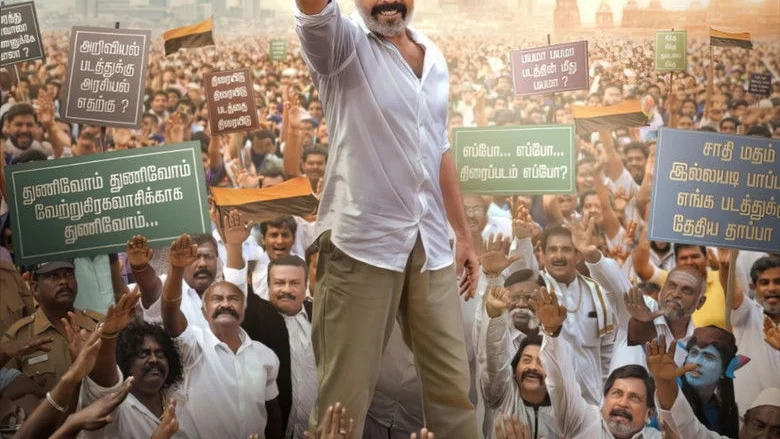
**Natty’s Kulkanth Kumar: charm without conviction**
Natarajan Subramaniam carries the lead as Golden Star Kulkanth Kumar, an actor stepping into the political arena. The casting signals intent, a performer-politician navigating systems designed to humiliate him, but the material never pushes him into terrain where we feel the genuine friction between stardom and statecraft.
**Ramaiah’s screenplay pulls in too many directions**
Thambi Ramaiah’s story and Umapathy Ramaiah’s screenplay attempt to layer feudal oppression, political maneuvering, and comedic relief into a single narrative frame. The strength lies in topical relevance: regressive honor codes meet electoral machinery, a collision that should spark. Yet the screenplay splinters focus, unable to establish which conflict demands primary attention, the landlord family’s stranglehold or the politician’s rise against institutional resistance.
**Political satire diluted by tonal uncertainty**
The film aspires to blend political commentary with entertainment, presenting socially relevant topics through humor. Darbuka Siva’s score attempts to amplify the tension between comedy and gravity, yet scenes oscillate between comedic beats and dramatic weight without establishing why the tonal shifts matter thematically.
Where the satire sharpens, moments hinting at how systems devour idealists or how feudal logic persists in democratic spaces, the narrative retreats into conventional storytelling. The thriller elements remain underdeveloped, lurking at the margins without crystallizing into genuine threat.
A 138-minute runtime can accommodate complexity, but only if screenplay discipline keeps competing tones tethered to a central argument. Here, the satire fractures under its own weight, unable to sustain the political edge long enough for it to cut.
**Supporting cast anchors without resonance**
MS Bhaskar, Ilavarasu, and Thambi Ramaiah populate the narrative with familiar presences. Their casting suggests archetypes, the feudal patriarch, the local power broker, the village elder, yet individual moments fail to crystallize their agency within the political machinery the film claims to interrogate.
**A premise outpacing its execution**
What remains troubling is the gap between concept and delivery. A story about feudal landlords wrestling with democratic processes, an actor-politician navigating both systems, and satire sharp enough to wound, these elements promise something incisive. Instead, TN 2026 settles for accommodation, never willing to alienate audiences through genuine political bite or character vulnerability.
The film targets all audience sections, which often signals a refusal to take risks. Here, that refusal reads as creative caution when the premise demands ruthlessness. Tamil political dramas have sharpened considerably in recent years; this one feels caught between eras.
Watch it for the premise and Darbuka Siva’s compositional choices, but expect a softer film than the stakes suggest. The theatrical window offers the best sense of scale, though the tonal inconsistencies persist regardless of format.
Tamil political comedies and thrillers remain underexplored territory, and Tamil Drama reviews continue to unearth ambitious misfire like this one.
TN 2026 – Thanga Natchathiram arrives with conviction but settles for compromise, a 2.5/5 film that mistakes topicality for satire and never finds the teeth its premise demands.
Umapathy Ramaiah’s tonal uncertainty echoes similar struggles in Mrithyunjay review, where multiple genre impulses dilute dramatic impact.
Both films wrestle with Tamil cinema’s shift toward political substance, sharing Youth verdict‘s struggle between ambition and execution.

Ankit Jaiswal is the Chief Author, covering Indian cinema and OTT releases with honest, no-filler criticism. An SEO strategist by background, he brings a research-driven approach to film writing, cutting through hype to tell you exactly what's worth your time.