Jeet Ki Zid (2026): Amit Sadh’s Paralysed Soldier Drama Refuses To Let The Battle End
The opening image is a pair of boots, immaculate, waiting for a man who will never lace them again. Vishal Mangalorkar’s military drama opens on the Kargil front and then does something braver than most Indian war films: it stays in the hospital corridor after the gunfire dies.
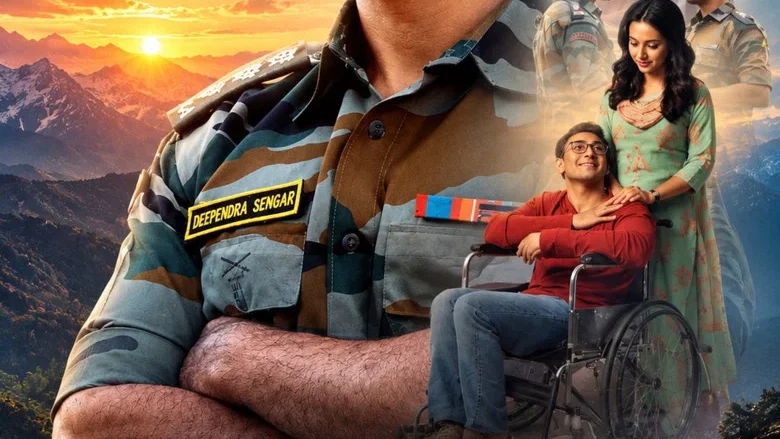
Major Deep Singh, played by Amit Sadh, is a Special Forces officer whose body is his entire professional vocabulary. When a wartime injury takes his legs, the film’s real mission begins, and it is fought entirely indoors.
A War Movie That Refuses To Leave The Recovery Room
The first act establishes Deep through physical competence: the way he moves through a briefing room, the clipped register of his voice when issuing orders, the reflexive straightening of his spine. That posture becomes the film’s most devastating casualty.
When the injury lands, Mangalorkar does not linger on the explosion. He cuts straight to the aftermath, the fluorescent wash of a military hospital, the indignity of being lifted, the silence of a man calculating what remains of him.
The structural gamble here is that the Kargil sequence occupies barely a quarter of the runtime. What follows is a rehabilitation drama wearing military fatigues, and the film commits to that inversion with a discipline that recalls the quieter spatial control of Poniiy, another recent release that trusted stillness over spectacle.
When A Soldier Loses The Only Language He Spoke
Deep’s psychological engine is not grief but redundancy. He has been trained to be useful, and paralysis renders him, in his own assessment, useless, a man whose country no longer requires his particular skills.
The screenplay’s smartest device is goal substitution. Battlefield objectives are replaced by rehabilitation milestones, and the film treats a first assisted step with the same dramatic weight a war film would give a hilltop capture. It is a transfer of military logic into the domestic sphere.
This is also where the film risks monotony. The middle stretch cycles through setback, encouragement, and renewed effort with a rhythm that occasionally feels less like escalation and more like repetition, and the emotional register stays locked in a single key.
Sadh’s Body Does The Work His Dialogue Cannot
The performance hinges on Amit Sadh’s physical vocabulary before and after the injury, and he calibrates the contrast with real precision. Watch his hands in the early scenes, they are always occupied, always doing something. After the injury, they lie flat on the bedsheet like surrendered weapons.
Sadh resists the temptation to play nobility. There is a scene in which Jaya tries to help him with something ordinary, and his jaw tightens before he lets her, a small, ugly flash of resentment that makes the character human rather than heroic.
Amrita Puri’s Jaya carries the film’s second emotional register, and she plays exhaustion rather than saintliness. Her silences in the domestic scenes do more narrative work than any speech about duty, and the marriage becomes a second rehabilitation in parallel.
Sushant Singh’s Colonel Is The Film’s Sharpest Instrument
Sushant Singh’s Colonel Ranjeet Chaudhary is not a villain, but he is the closest thing to an antagonist the film has, an institutional voice that refuses to indulge Deep’s self-pity. He visits the hospital not to comfort but to provoke.
In one confrontation, the Colonel stands at the foot of the bed, hands clasped behind his back, and delivers his challenge without raising his voice. The framing keeps him slightly above Sadh’s eyeline, and the power geometry does the work that dialogue alone could not.
The supporting ensemble around Deep’s family registers as texture rather than character, the parents, the extended military circle, and the film does not give them enough interiority to justify their screen time. They function as a chorus of concern, nothing more.
Where The Direction Finds Its Feet And Where It Stumbles
Mangalorkar’s camera stays close and low during the recovery sequences, keeping Deep’s eyeline at bed height so the audience shares his restricted horizon. When he finally stands, the camera rises with him, and the release is genuinely earned.
The film’s weakness is its score, which insists on emotional instruction at moments that would land harder in silence. A rehabilitation montage in the second hour is drowned in swelling strings when the physical effort alone was sufficient.
The editing is more confident than the music. The transition from combat to hospital is abrupt by design, and the film resists the flashback structure that would have softened the shock. That refusal to console the audience is its most adult instinct.
Where the screenplay falters is in its handling of the social dimension. The film gestures at how a disabled veteran is viewed by the world outside the hospital, but it never sits with that discomfort long enough to complicate the inspirational arc, settling instead for a cleaner, more digestible resolution than the premise demanded.
The OTT Calculation Behind A Soldier’s Second Life
Released directly on ZEE5 rather than through a theatrical window, the film’s commercial logic is legible: military inspiration dramas perform reliably on streaming, where they reach the family audience that a crowded theatrical slate would fragment. The platform gets a prestige-adjacent title with a recognisable lead; Sadh gets a role that stretches him beyond the uniform.
What is financially at stake is the sustainability of the mid-budget inspirational drama as a streaming category. The film does not need to open a weekend; it needs to hold a subscriber’s attention for two hours and ten minutes, and on that measure its disciplined pacing serves it well.
The risk is that the format encourages exactly the kind of soft-focus resolution the third act delivers. A theatrical release would have demanded a harder, more cinematic climax; the streaming model permits the gentler one the film ultimately chooses.
This tension between inspirational formula and genuine psychological complexity is the same fault line running through much of contemporary Hindi action, where the genre’s commercial instincts and its more serious ambitions are still negotiating a truce.
A Recovery That Earns Its Tears But Not Its Complexity
The final act delivers the standing-up moment the premise promises, and it lands because the film has spent its runtime building the physical cost of every inch. Sadh’s face during the sequence is a study in controlled exertion rather than triumph, and that restraint is the film’s best argument for itself.
But the resolution arrives too cleanly. The film treats recovery as a binary, paralysed, then standing, and skips the messier, more honest middle ground of partial function and permanent limitation. The inspirational frame requires a victory; the subject deserved a more complicated one.
What remains is a film that is genuinely moving in its best passages and genuinely conventional in its weakest, a portrait of a soldier whose real war was fought after the ceasefire and whose real enemy was the story’s own need to console.
Jeet Ki Zid understands that the hardest battle is the one fought in a hospital bed, and it earns its tears honestly enough. It just never quite trusts its audience to sit with the ache a little longer, and that, finally, is the wound the film leaves unexamined.

Ankit Jaiswal is the Chief Author, covering Indian cinema and OTT releases with honest, no-filler criticism. An SEO strategist by background, he brings a research-driven approach to film writing, cutting through hype to tell you exactly what's worth your time.