Jailer 2 (2026): Rajinikanth’s Return Feels Like a Victory Lap Without a Race
The most dangerous thing about Tiger Muthuvel Pandian is not his fists. It is the way he sits still in a room full of enemies and lets them talk themselves into a corner.
That stillness is the entire thesis of Jailer 2, Nelson Dilipkumar’s sequel to his 2023 blockbuster, and it is also the film’s central problem. The film opens with Rajinikanth’s retired jailer attempting domestic invisibility, tending to his family and avoiding the violent methods that defined his past. Within twenty minutes, a syndicate’s reach touches his daughter-in-law Shwetha and the fragile peace collapses. The question is not whether Tiger will return to violence. It is whether the film has anything new to say when he does.
The Retirement Premise Is a Reversal, Not a Reinvention
Nelson understands that a sequel cannot simply reset its hero. The first Jailer ended with Tiger having dismantled a smuggling empire and reclaimed a version of his family. Jailer 2 begins with the cost of that victory: a man who knows exactly what he is capable of, choosing restraint, and failing.
The film’s strongest structural choice is making the threat personal before it becomes operational. The syndicate does not announce itself with a grand villain monologue. It arrives through small intrusions, a phone call, a shadow outside a window, a name mentioned in the wrong room. Nelson stages these early beats with a patience that recalls the tighter spatial discipline he showed in Afreet – A Never, where atmosphere did the work that dialogue could not.
But patience only works if the payoff justifies it. Here, the film’s middle section stretches the syndicate’s expansion across nearly an hour without clarifying what the syndicate actually wants beyond generic criminal reach. The network is large, the threat is real, and the mechanics remain frustratingly vague.
When the Villain Is a Position, Not a Person
S. J. Suryah’s Bodhi Kalpak is positioned as the film’s pivotal antagonist, and Suryah brings a coiled, theatrical menace to the role. His best moments are physical: a slow turn of the head, a smile that never reaches the eyes, a hand resting too casually on a shoulder. He understands that the most effective villains are the ones who enjoy the conversation before the violence.
But the screenplay never gives Bodhi a coherent operational logic. He is a threat because the film tells us he is a threat, not because we understand what he gains from Tiger’s suffering. The restrained physical exhaustion Rajinikanth brings to the final confrontation recalls the psychological weight of his work in Love Insurance Kompany, where presence alone carried scenes that the writing could not. Here, the writing does not meet him halfway.
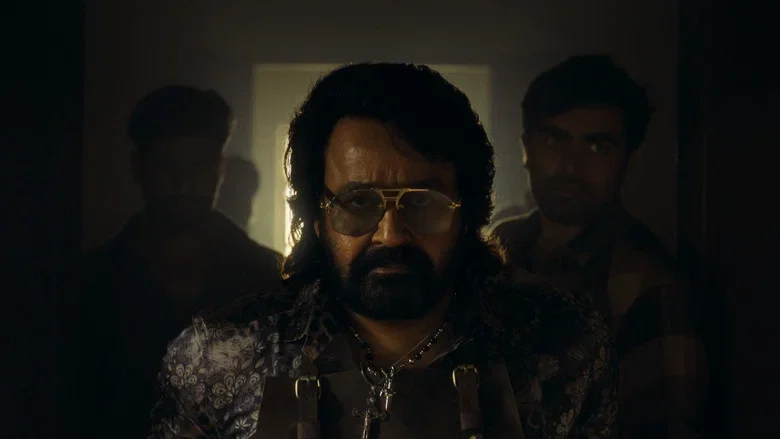
Mohanlal and Shiva Rajkumar return as Mathew and Narasimha, and their reunion with Tiger is the film’s most effective sequence. The three men share a table, a history, and a silence that says more than the exposition that follows. When they move into coordinated action, the film briefly becomes the multinational criminal-network thriller it wants to be.
The Action Is Choreographed, Not Dramatized
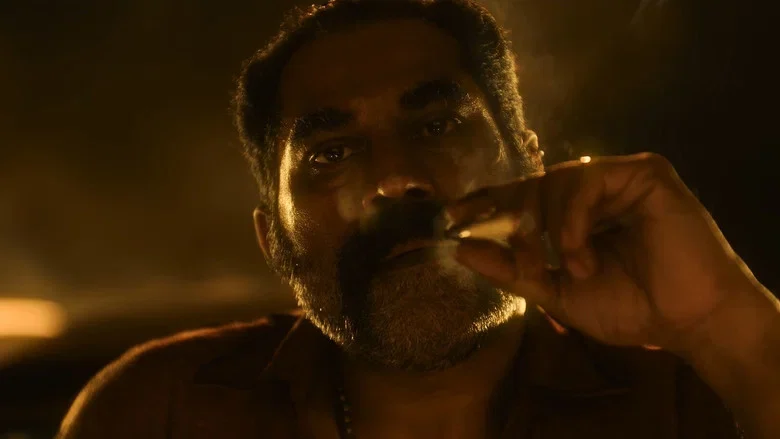
Nelson’s camera favors medium shots during confrontations, keeping Rajinikanth’s face in frame even when the violence moves off-screen. It is a smart choice for a star whose age demands a different kind of action grammar. The film does not ask him to leap from helicopters. It asks him to stand still while the world moves around him.
That approach works in isolated moments. A sequence where Tiger walks through a corridor while the sound drops to a low hum, footsteps echoing, is genuinely tense. But the film’s larger set pieces rely on cutting and volume rather than spatial coherence. The IMAX presentation amplifies scale, but scale without geography is just noise.
Anirudh Ravichander’s score is deployed with expected precision, swelling when Tiger makes his decision and dropping when the film wants us to feel the weight of it. The problem is that the score is doing work the screenplay has not earned. A musical cue can underline an emotion, but it cannot manufacture one. The screenplay resists the kinetic sensationalism that overtook Reporting Live, opting instead for a slower burn, but it never commits fully to the tension that approach requires.
The Family Is the Stakes, Not the Story
Ramya Krishnan returns as Ashtalakshmi, and Mirnaa’s Shwetha is positioned as the emotional anchor of Tiger’s decision to return to violence. Both performers do what they can with limited screen time, but the film treats the family as a motivation rather than a lived reality. We are told Tiger loves them. We rarely see him with them in a moment that is not about the threat.
The supporting cast is large, and the film does not always know what to do with it. Yogi Babu returns in a comic-relief role that feels disconnected from the film’s darker register. Other familiar faces appear and disappear without leaving a mark. The ensemble is a collection of names rather than a network of characters.
This is where Jailer 2 differs most from its predecessor. The first film was built around a single, devastating reveal about Tiger’s past. The sequel assumes we already know who he is and asks us to care about what he might lose. That is a harder sell, and the film does not always make it.
Sun Pictures Is Betting on the Star, Not the Story
Sun Pictures has built its recent slate around large-scale theatrical events, and Jailer 2 is the studio’s most expensive bet of the year. The reported opening-day figures, ₹21.19 crore India net by 1 p.m., rising to ₹33.48 crore by 5 p.m., confirm that the star’s theatrical leverage remains formidable. The advance bookings, reported at ₹58.92 crore, suggest that audiences are willing to show up for Rajinikanth even when the material is uncertain.
But the sequel pipeline is not infinite. Tamil cinema’s reliance on star-driven franchises has produced diminishing returns in recent years, and Jailer 2’s extended runtime and uneven pacing test the patience of even devoted fans. The film’s commercial success will depend on whether word-of-mouth can sustain the opening weekend. The star can open a film. He cannot carry it alone. This patient character study signals a welcome tonal maturity across contemporary tamil thrillers, proving that tension thrives without manufactured plot theatrics, but maturity without momentum is just a slower way to lose the room.
The Ending Leaves a Question the Film Cannot Answer
The final confrontation resolves the immediate threat, but the film’s closing image is less about victory than exhaustion. Tiger has returned to violence, protected his family, and ended up exactly where he started. The sequel’s central question, can a man shaped by violence protect his family without becoming what he tried to leave behind, is answered with a shrug.
Rajinikanth holds the final frame with a weariness that suggests he understands the contradiction better than the screenplay does. He has been here before. He will be here again. The film ends not with a resolution but with a recognition: the cycle continues because the industry, and the audience, will not let it end.
Jailer 2 is not a failure. It is a film that knows exactly what it is and never tries to be more. For Rajinikanth’s fans, that will be enough. For anyone hoping the sequel might sharpen the first film’s themes or deepen its characters, the film offers the same comfort as a reunion: familiar, warm, and ultimately unchanged.

Ankit Jaiswal is the Chief Author, covering Indian cinema and OTT releases with honest, no-filler criticism. An SEO strategist by background, he brings a research-driven approach to film writing, cutting through hype to tell you exactly what's worth your time.