Nanhey Dil (2026): Suniel Shetty’s Mentor Turn Anchors a Gentle, Uneven Schoolyard Fable
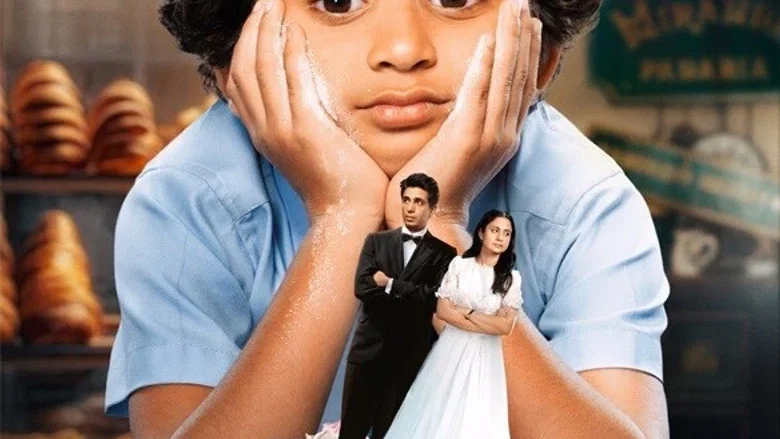
Raghu crosses the school threshold and the room tilts. A washerman’s son in a blazer that still carries the crease of a borrowed life, he is a small body swallowed by marble corridors and English consonants.
Swarupraj Medara’s debut is a film about that tilt, and about the slow, unglamorous work of righting it.
A Washerman’s Son And The Grammar Of Belonging
The premise is clean, almost austere in its refusal to inflate. Principal Anthony spots something in Raghu, a brightness that the classroom’s fee structure would otherwise bury, and opens a door that the school’s social architecture was built to keep shut.
What Medara grasps is that the barrier is not a gatekeeper. It is the corridor itself: the way affluent children hold their shoulders, the clipped rhythm of their sentences, the assumption that the world answers when they speak.
Raghu’s fear is played not as timidity but as translation lag, the half-second before he understands, and the second half-second before he decides whether to speak at all.
When Kindness Replaces Confrontation, The Drama Loses Its Teeth
The middle hour commits to a friendship arc built on shared food and small gestures, and this is where the film is both most humane and most structurally timid.
Homemade tiffin becomes the bridge between Raghu and six privileged classmates, and Medara stages the thaw with patience, a bench shared, a plate passed, a laugh that catches before the mind can veto it.
But the screenplay never lets the class conflict bite back. The rich kids are merely unformed, not unkind; the institution is merely unaware, not complicit. A film that names hierarchy so precisely in its first act grows reluctant to interrogate it in its second.
Where a sharper dramatist might have let the exclusion calcify into something genuinely ugly before the thaw, Medara reaches for warmth early and often, and the result plays closer to a school assembly than a reckoning.
Suniel Shetty’s Stillness And The Weight Of Institutional Permission
Shetty’s Principal Anthony is the film’s quiet load-bearing wall. He does not speechify; he observes, and the performance lives in the pause before he speaks, a man measuring a child’s potential against the school’s inertia.
There is a specific gesture early on, a hand resting flat on a desk as he decides, that carries more authority than any dialogue the script hands him.
It recalls the weary, grounded physicality he brought to the ensemble turmoil of Welcome to the Jungle, but here it is scaled down to a single room and a single decision.
Young Sarvesh Adawade shoulders the harder task. His Raghu is built from micro-corrections, the downward glance, the hands folded too tightly, the visible recalibration of the spine when a classmate finally addresses him without pity.
The child ensemble around him functions as a collective texture rather than a set of individuals, and Medara rarely gives any one of the six a sustained close-up that would let us know them as people rather than as a thawing bloc.
Medara’s Patient Camera And The Cost Of Under-Dramatized Space
Medara’s staging favors the institutional wide, the long corridor, the assembly ground, the classroom shot from the back so that Raghu appears as the smallest object in a composed frame.
It is a coherent visual idea: the child diminished by architecture. But the film too rarely reverses it. We wait for the shot that puts Raghu at the center of the frame with the room bending around him, and it arrives late, if at all.
Shailesh Suvarna’s score leans on soft piano and strings, and it tends to arrive before the emotion has been earned, cueing the tears rather than trusting the scene to produce them.
The editing keeps a steady, linear hand, though the first half’s accumulation of small humiliations is more patient than the second half’s rush toward acceptance, which compresses weeks of thaw into a handful of scenes.
The Remake Pipeline And What A Small Drama Owes Its Studio
The commercial math here is modest and precarious. A U-rated, child-centered Hindi drama with a recognizable star in a supporting mentor role is a hard theatrical sell in a market that rewards scale and spectacle.
Suniel Shetty’s box-office leverage has shifted decisively toward ensemble and character work, and Nanhey Dil asks his name to sell a film whose true lead is a child, a proposition that rarely recovers its print-and-advertising spend in the opening weekend.
The producers behind the film are betting on the family-matinee audience, and the film’s gentleness is both its asset and its commercial liability: it will play beautifully to parents, and it will struggle to generate the urgency that drives opening-day footfalls.
Against the louder, more uneven swings of the current theatrical slate, the kind of scattershot comedy that Party Animals represents, this film is the quieter, more disciplined proposition, even if it is the one less likely to fill a Friday.
A Fable That Trusts Its Audience A Little Too Much
The film’s resolution is generous: Raghu belongs, the six belong to him, and the school is quietly, imperfectly changed. It is a hopeful ending, and an honest one for the genre it occupies.
But it arrives without the friction that would make it feel earned. The class hierarchy that the opening act so carefully anatomized is never truly confronted; it is simply softened by one child’s decency, which is a lovely sentiment and a thin argument.
That tension, between the film’s clear-eyed diagnosis and its sentimental cure, is the same unresolved knot that gives Pratap its uneasy charge, though Medara’s film lacks the nerve to sit in it.
What remains is a modest, well-intentioned debut with a genuine performance at its center and a script that mistakes warmth for resolution.
It is a film about a boy learning the grammar of a world that was not built for him, made by a filmmaker still learning the grammar of his own medium, and in that symmetry, there is something quietly worth watching.
Across contemporary Hindi dramas, that kind of sincerity is rarer than it should be, even when it arrives half-formed.

Ankit Jaiswal is the Chief Author, covering Indian cinema and OTT releases with honest, no-filler criticism. An SEO strategist by background, he brings a research-driven approach to film writing, cutting through hype to tell you exactly what's worth your time.