Raamaayan: Rise of a Legend (2026): Ranbir Kapoor’s Divine Burden Meets Yash’s Magnetic Ravana in an Incomplete Epic
The cosmic churn of Brahma, Vishnu, and Shiva opens Nitesh Tiwari’s massive gamble, but the real ignition arrives when a lesser Asura king refuses to kneel. This is a world built on the architecture of vengeance, not devotion.
The Liberator’s Prayer That Curdles Into Conquest
Yash’s Ravana does not enter as a snarling villain. He enters as a politician of the oppressed, a clan leader demanding power to free his enslaved people from Deva dominion.
That ideological starting point is the film’s most radical structural choice. When his prayer for strength mutates into a campaign of neighbouring-city annihilation, the screenplay refuses to let him become a cartoon.
The transformation is staged with deliberate political texture, echoing the kind of grounded genre deconstruction seen in Aadu 3, where familiar mythological frameworks are bent toward darker, more feral ends. Here, the bend is toward empire.
When a Divine Incarnation Becomes a Bureaucratic Duty
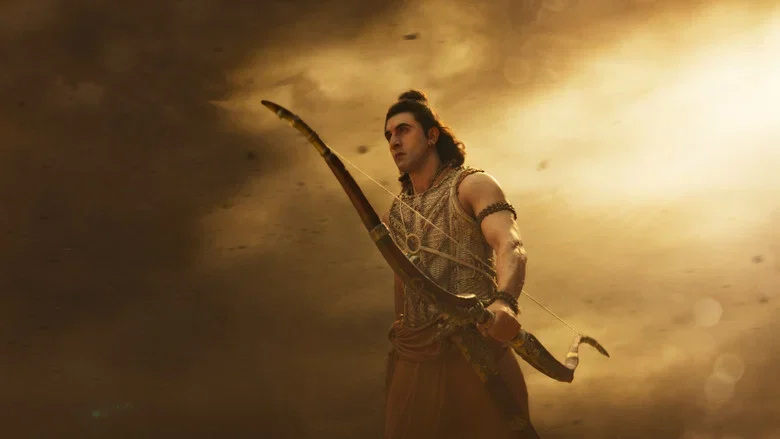
Ranbir Kapoor’s Rama is introduced as the cosmic answer to Ravana’s ascent, but the film wisely delays the godhead. He is first a prince bound by sacrifice, a son whose obedience feels heavier than any celestial mandate.
The marriage to Sai Pallavi’s Sita is staged with quiet domestic warmth, a brief pocket of intimacy before the exile machinery grinds into motion. Pallavi holds the frame with a stillness that suggests emotional endurance rather than decorative piety.
Where the film stumbles is in the expositional density of its first hour. Cosmic prologue, Asura politics, Ayodhya’s royal hierarchy, and the exile decree all compete for oxygen, and the pacing sags under the weight of its own world-building.
The Stillness That Manufactures Pressure
Kapoor’s physical restraint is the performance’s defining asset. He plays Rama with a jaw held tight and eyes that register duty as a kind of slow suffocation, never once reaching for heroic swagger.
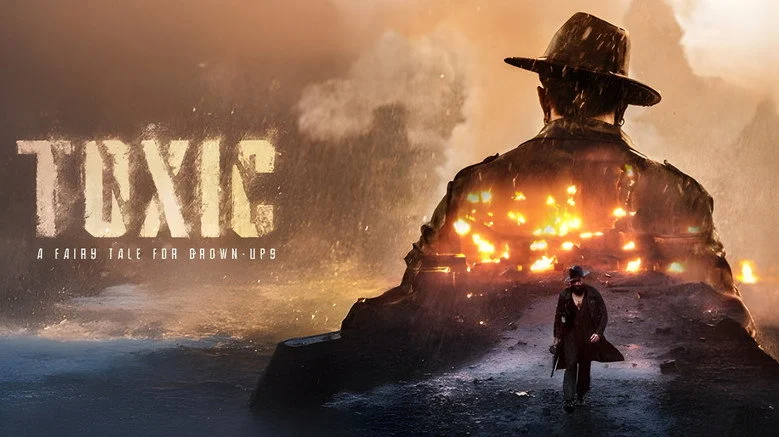
That restraint recalls the psychological weight he carried in Toxic, though here the exhaustion is spiritual rather than criminal. The contrast is instructive: same intensity, entirely different moral register.
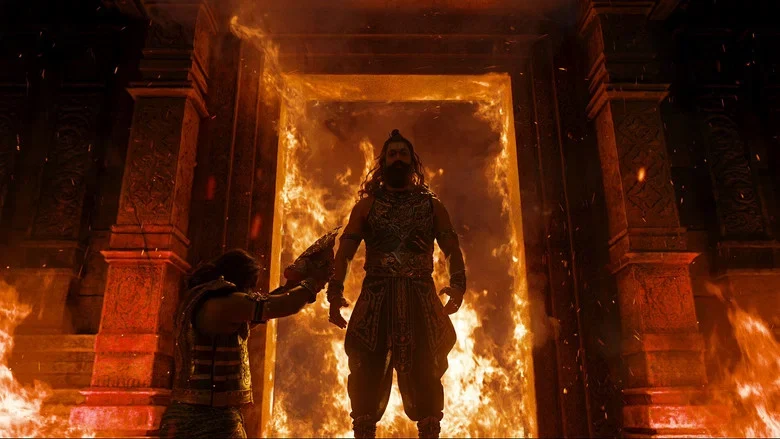
Yash, meanwhile, commands the frame through sheer spatial dominance. His Ravana occupies doorways and throne rooms as if the architecture itself should bow, and his voice drops into a register that makes even his political grievances sound like threats.
The supporting ensemble is largely reduced to royal functionaries. Lara Dutta’s Kaikeyi and Sheeba Chaddha’s Manthara execute palace intrigue with precision, but the script gives them little room to breathe beyond their narrative utility.
Audiovisual Grandeur That Occasionally Betrays the Drama
Hans Zimmer and A.R. Rahman’s score is deployed with deliberate restraint in the Rama-Sita sequences, allowing silence to do the emotional work. But the battle and cosmic sequences are drowned in percussive bombast that flattens nuance.
The CGI-heavy visual strategy, while ambitious in scope, creates a curious distance. The mythological worlds of Lanka and Ayodhya feel expansive but rarely tactile, as if the characters are moving through a beautifully rendered diorama rather than a lived-in space.
Tiwari’s direction shows a tighter spatial discipline than his muted homecoming drama in Dilwali Diwali, but the emotional intimacy that defined that film is often sacrificed here for scale.
The Two-Part Gamble and the Studio Balance Sheet
Prime Focus Studios, DNEG, and Yash’s Monster Mind Creations have staked a reported ₹4, 000 crore combined budget on this two-part adaptation. That figure alone makes the first instalment a commercial tightrope walk.
The international retitling from an explicit “Part 1” to “Rise of a Legend” is a marketing decision that may backfire. Audiences expecting a self-contained epic will find themselves watching a very expensive, very polished prologue.
The theatrical franchise lifecycle for mythological IP is entering a precarious phase. The regional remake pipeline is saturating, and original mythological spectacles must now justify their existence beyond visual novelty, a challenge that contemporary hindi fantasys are increasingly forced to confront.
The Uncomfortable Resolution of a Story That Refuses to End
The film’s dramatic endpoint is not a resolution but a positioning. Rama and Ravana are established as opposing destinies, and the audience is left holding the bill for a second chapter.
This is a film that trusts its mythology enough to withhold catharsis, but it underestimates how much audiences need a complete emotional arc. The cliffhanger feels less like suspense and more like a contractual obligation.
What lingers is not the spectacle but the ideological tragedy of Ravana. A liberator who becomes a tyrant is a more interesting figure than a demon who was always evil, and Yash’s performance ensures that tragedy lands.
Ramayana: Rise of a Legend is a grand, flawed opening chapter that mistakes scale for substance in its weaker moments. But when Yash’s Ravana stares down the divine order, the film briefly becomes the epic it wants to be.

Ankit Jaiswal is the Chief Author, covering Indian cinema and OTT releases with honest, no-filler criticism. An SEO strategist by background, he brings a research-driven approach to film writing, cutting through hype to tell you exactly what's worth your time.